


.png)

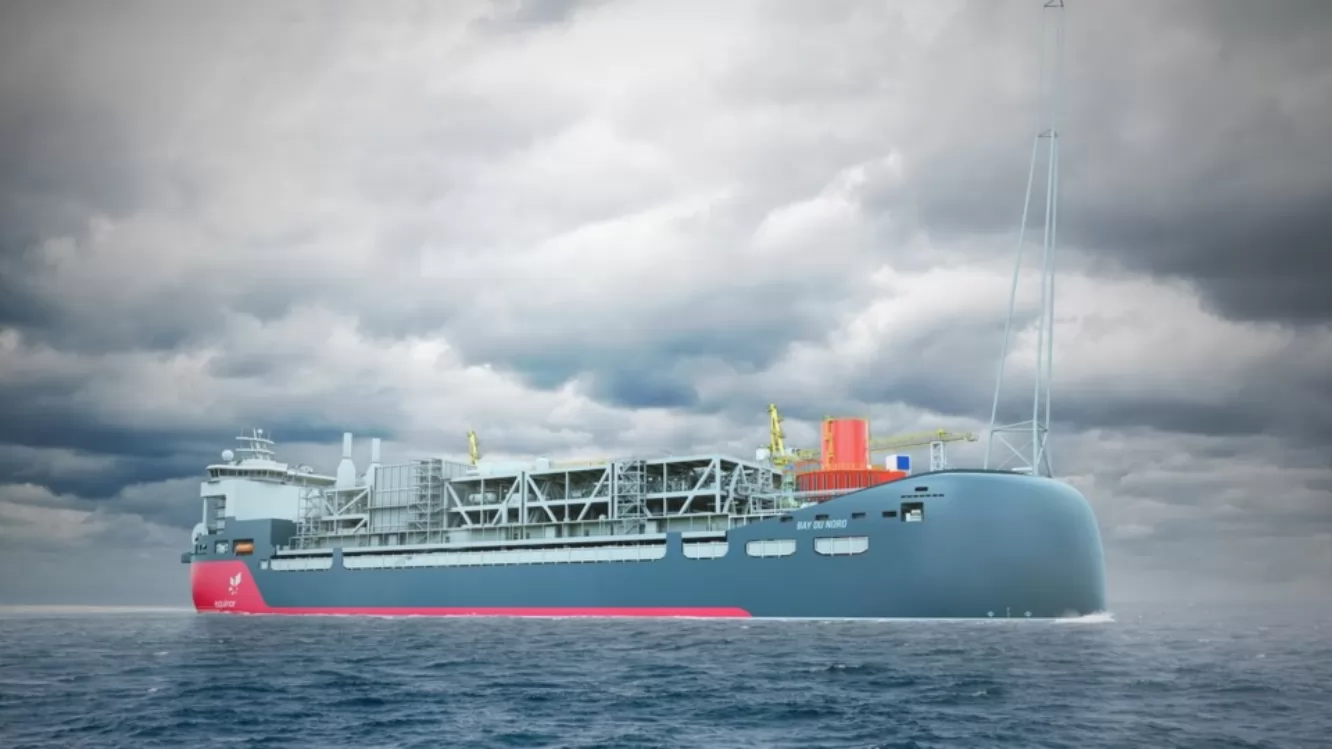
The offshore oil development at Equinor’s Bay du Nord project has entered a key new stage, with FPSO contractor BW Offshore signing a Front-End Engineering and Design (FEED) agreement for the floating production system offshore Canada.
The agreement marks a formal progression toward project sanction and supports continued maturation of one of the most significant deepwater oil developments in North America.
The Bay du Nord development is located in the Flemish Pass Basin, approximately 500 km offshore Newfoundland and Labrador, Canada. It is considered one of the country’s most important new offshore oil developments, with recoverable reserves estimated at around 400 million barrels in its initial phase.
Operated by Equinor in partnership with BP, the project is designed as a long-life deepwater development hub, with future subsea tie-back opportunities expected to extend production beyond the initial fields.
If sanctioned, the project is expected to become Canada’s first standalone deepwater oil production system and a major contributor to Atlantic offshore output.
The FEED (Front-End Engineering and Design) phase will focus on:
· Finalizing FPSO configuration and process design
· Optimizing offshore production capacity and safety systems
· Defining execution schedule and installation strategy
· Selecting key subcontractors and long-lead suppliers
· Aligning commercial terms ahead of final investment decision (FID)
The FEED phase is expected to run through 2026, with FID targeted around 2027, depending on regulatory and commercial approvals.
The Bay du Nord development is based on a large-scale FPSO (Floating Production, Storage and Offloading unit) designed for sub-Arctic offshore conditions.
Key FPSO features include:
· Production capacity of up to ~160,000 barrels/day
· Disconnectable turret system for ice and harsh weather safety
· Winterization packages for low-temperature operation
· Emission reduction systems (efficient power generation, heat recovery, closed flare system)
· Future tie-back capability for satellite fields
This design reflects a global trend toward high-capacity, multi-field FPSO hubs rather than single-field offshore developments.
The project will require a full suite of offshore oil and gas systems, including:
· Subsea trees and wellheads
· Manifolds and control systems
· Flowlines, risers, and umbilicals
· Subsea control modules for remote operation
· Oil/gas separation trains
· Gas compression systems
· Produced water treatment units
· Gas dehydration and export systems
· Hull storage tanks
· Mooring and turret systems
· Offloading systems for shuttle tankers
Given the harsh offshore environment and complex fluid composition, material selection is a critical engineering factor.
Typical materials expected in the project include:
· Carbon steel for structural and low-corrosion components
· Stainless steel (316L) for moderate corrosion resistance systems
· Duplex stainless steel for seawater and chloride-rich environments
· Nickel-based alloys for high-pressure and corrosive service conditions
However, due to cost and weight optimization challenges, hybrid material solutions are increasingly preferred in FPSO projects.
A key engineering solution expected in Bay du Nord is the use of clad plate materials, which combine carbon steel strength with a corrosion-resistant alloy (CRA) lining such as stainless steel or nickel alloys.
This solution is widely used in large-scale offshore developments to balance cost efficiency and corrosion resistance.
Clad plates are commonly used in:
· Three-phase separators
· Gas scrubbers
· Knock-out drums
These vessels handle multiphase production fluids containing CO₂, water, and potential sour components.
Heat exchangers are critical in FPSO process systems. Clad materials are typically used for:
· Shells and channel heads
· Tubesheets
· High-corrosion zones exposed to seawater cooling systems
Clad plate construction is also suitable for:
· Produced water treatment vessels
· Slop tanks
· Chemical injection and storage tanks
While clad plates are not directly used subsea, similar technology is applied through:
· Clad pipes
· CRA-lined pipelines
These ensure internal corrosion resistance while maintaining structural strength for long-distance hydrocarbon transport.
The Bay du Nord project reflects several key offshore industry trends:
· Growth of deepwater FPSO-based developments
· Increasing reliance on subsea tie-back networks
· Strong focus on lifecycle cost optimization
· Wider use of clad materials and duplex alloys in process systems
As offshore projects move into harsher environments, material engineering is becoming as critical as production design itself.
With FEED progressing, Bay du Nord is advancing toward a potential final investment decision around 2027. If approved, first oil could be achieved in the early 2030s, establishing a new offshore production hub in Atlantic Canada.
The project is expected to generate long-term demand for FPSO fabrication, subsea systems, and advanced corrosion-resistant materials, including clad plate solutions for critical process equipment.
Nanjing Fugo New Material Tech Co., Ltd. (Fugo Tech) is an ISO 9001 and PED 2014/68/EU certified manufacturer specializing in Clad Material (Explosive Clad Plates & Rolled Clad Plates/Clad Dish Heads/Clad Tube Sheets) and Titanium, Nickel Alloy, Copper Alloy and Stainless Steel products (Pipe/Tube/Fitting/Flange/Forging) which are widely used in the Heat Exchanger, Pressure Vessel, Reactor, Column, Tower, and other process equipment.
Fugo Tech offers different material combinations of Clad Plate (Explosion-welded clad plate/composite plate & Rolled-welded clad plate/composite plate) , and also offers a wide range of materials, including Titanium, Nickel Alloy, Copper, Cu-Ni, and Stainless Steel, along with custom processing services (Tube Sheet drilling, and Dish Head forming) for Oil & Gas, Petrochemical, Chemical, Energy, Paper & Pulp, Marine, Shipbuilding, Environment, Metallurgy, and New Energy Vehicles, with a strong focus on high-performance Clad Plate & Titanium & Nickel Alloy & Stainless Steel solutions.
For any new requirement, please contact: sales@fugo-tech.com
















Fugo Tech is focused on the manufacturing of clad metal plate and distributes the Stainless Steel, Titanium, Nickel Alloy, Zirconium and other non-ferrous metal pipes, fittings, and flanges.