


.png)

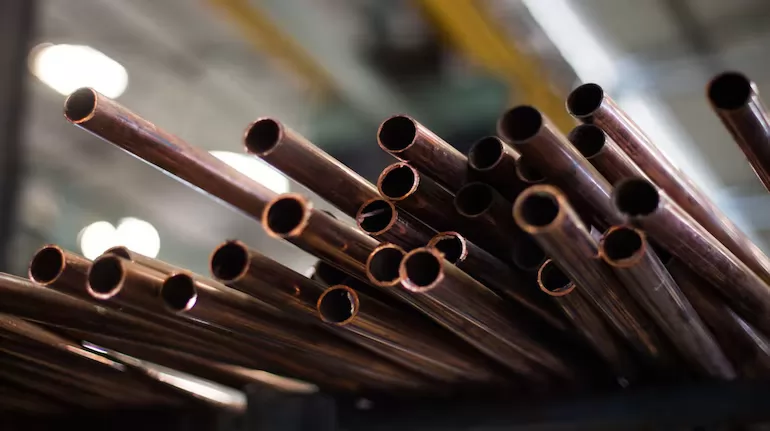
Copper has surged into the spotlight as one of the most dynamic industrial metals going into 2026 — and for good reason.
After a strong performance through 2025, copper prices climbed to record levels, driven by tightening supply, strategic demand growth, and fundamental shifts in how global inventories are managed. These trends are now setting up a constructive outlook for 2026, with key catalysts that market participants — from fabricators to project engineers — should be watching closely.
Copper’s rally is not simply cyclical. Rather, it reflects a structural tightening in the market:
Supply disruptions in major copper districts — including flooding and mine shutdowns — have pushed the market into a deficit sooner than expected.
Traditional inventory mechanisms that once smoothed global supply flows are now constrained, partly due to regional stockpiling and policy uncertainty.
Treatment charges — fees smelters collect to process mined ore into refined metal — have collapsed, indicating concentrate is scarce relative to smelter demand.
These supply weaknesses help explain why copper continues to trade near all-time highs.
Copper’s demand profile is shifting away from being solely tied to conventional industrial cycles. New, less price-sensitive drivers are emerging that support sustained demand growth:
Investment in electricity grids, power distribution networks, and smart infrastructure requires significantly more copper, especially for durable cabling and transformer systems.
AI-enabled computing infrastructure consumes large volumes of copper for power delivery and connectivity — far more than legacy data centers. This trend is reshaping copper consumption in IT and industrial ecosystems.
Defense modernization efforts are adding a layer of demand that is less dependent on economic cycles and more linked to national security priorities.
These strategic drivers help explain why copper remains strong even amid slower growth in some traditional end markets.
Policy risk continues to be a significant catalyst for copper price behavior:
Tariff uncertainty — especially potential changes under trade-related frameworks — has fragmented global inventories and encouraged stockpiling in certain jurisdictions.
Such fragmentation means copper doesn’t behave like a single global pool of inventory; instead, localized tightness can persist and amplify price impacts.
These dynamics make copper more sensitive to policy developments and strategic stock movements than in typical supply-demand cycles.
With supply constraints expected to continue — due to long lead times for new mine development, declining ore grades, and limited spare processing capacity — the market’s ability to respond to demand growth remains restricted.
At the same time, strategic demand drivers like electrification, AI infrastructure, and grid expansion are expected to remain durable well into the mid-2020s and beyond.
Taken together, these factors point to a more structural copper market — where prices may stay supported above historical norms and where volatility can be driven as much by supply inflexibility as by cyclical demand swings.
For EPC contractors, fabricators, and project planners in industries like:
Oil & Gas
Chemical Processing
Petrochemical
Water & Wastewater Treatment
Paper & Pulp
Power Generation
the implications are clear:
Raw material prices, especially for copper and related specialty alloys, are becoming more volatile and increasingly subject to strategic demand and policy risk.
In this environment, traditional reliance on solid alloy solutions for corrosion resistance, electrical conductivity, or durability may expose projects to higher costs and supply risk.
One practical way to mitigate metal market volatility and reduce total project cost is through engineered composite materials such as explosion-bonded and roll-bonded clad plates — especially where corrosion resistance and structural performance are critical.
✔ Lower dependence on full-section expensive alloys
By placing high-performance metal only where it’s needed on the surface, clad plates reduce reliance on solid high-alloy materials.
✔ Corrosion resistance for aggressive environments
Ideal for applications in aggressive service media where materials like nickel alloys, duplex stainless steels, and titanium are often specified.
✔ Fabrication efficiency
Easier to weld, bend, and assemble than thick solid alloys.
✔ Cost optimization
Reduces total material costs while maintaining technical performance for pressure vessels, column linings, heat exchangers, reactors, and piping systems.
Nanjing Fugo New Material Tech Co., Ltd. (Fugo Tech) is an ISO 9001 and PED 2014/68/EU certified manufacturer specializing in Clad Material (Explosive Clad Plates & Rolled Clad Plates/Clad Dish Heads/Clad Tube Sheets) and Titanium, Nickel Alloy, Copper Alloy and Stainless Steel products (Pipe/Tube/Fitting/Flange/Forging) which are widely used in the Heat Exchanger, Pressure Vessel, Reactor, Column, Tower, and other process equipment.
Fugo Tech offers different material combinations of Clad Plate (Explosion-welded clad plate/composite plate & Rolled-welded clad plate/composite plate) , and also offers a wide range of materials, including Titanium, Nickel Alloy, Copper, Cu-Ni, and Stainless Steel, along with custom processing services (Tube Sheet drilling, and Dish Head forming) for Oil & Gas, Petrochemical, Chemical, Energy, Paper & Pulp, Marine, Shipbuilding, Environment, Metallurgy, and New Energy Vehicles, with a strong focus on high-performance Clad Plate & Titanium & Nickel Alloy & Stainless Steel solutions.
For any new requirement, please contact: sales@fugo-tech.com

















Fugo Tech is focused on the manufacturing of clad metal plate and distributes the Stainless Steel, Titanium, Nickel Alloy, Zirconium and other non-ferrous metal pipes, fittings, flanges, and fasteners.